Your name hereExample post · preview
Share a track, a lyric, a photo or a work in progress. This is where your community sees it first.
YOUR SPACE
Make your profile feel like you. Keep your bio, photo, links, friends, and community posts together.

MISUNDERSTOOD & COMPANY · FOUNDED JULY 2025
Your music, your people, and practical tools to build what comes next.
Share a track, a lyric, a photo or a work in progress. This is where your community sees it first.
Likes, comments and #hashtags help the right people find the work.
Follow the artists you love and see their updates in For You.
The hashtags members use most appear here, so you can see what the community is talking about.
Ten thousand followers on TikTok, and a platform that keeps pushing artists and individuals to think outside the box.
Confirm the rights, credits and identifiers first.
MUSIC, PEOPLE, INDEPENDENCE
A home for independent artists to share their work, meet their audience, and build what comes next.
MISUNDERSTOOD & COMPANY · NEWSROOM · REPORTING · ARTIST RIGHTS & ARTIFICIAL INTELLIGENCE
Two lawsuits targeting AI music company Suno have brought the fight over music ownership into sharper focus. Copyright holders connected to Elvis Presley and Eminem allege that their protected works were used to train generative AI without authorization. But the controversy reaches far beyond two legendary catalogs: it raises fundamental questions about artistic identity, digital voice replication, copyright law, and whether musicians will be compensated when machines learn their work.
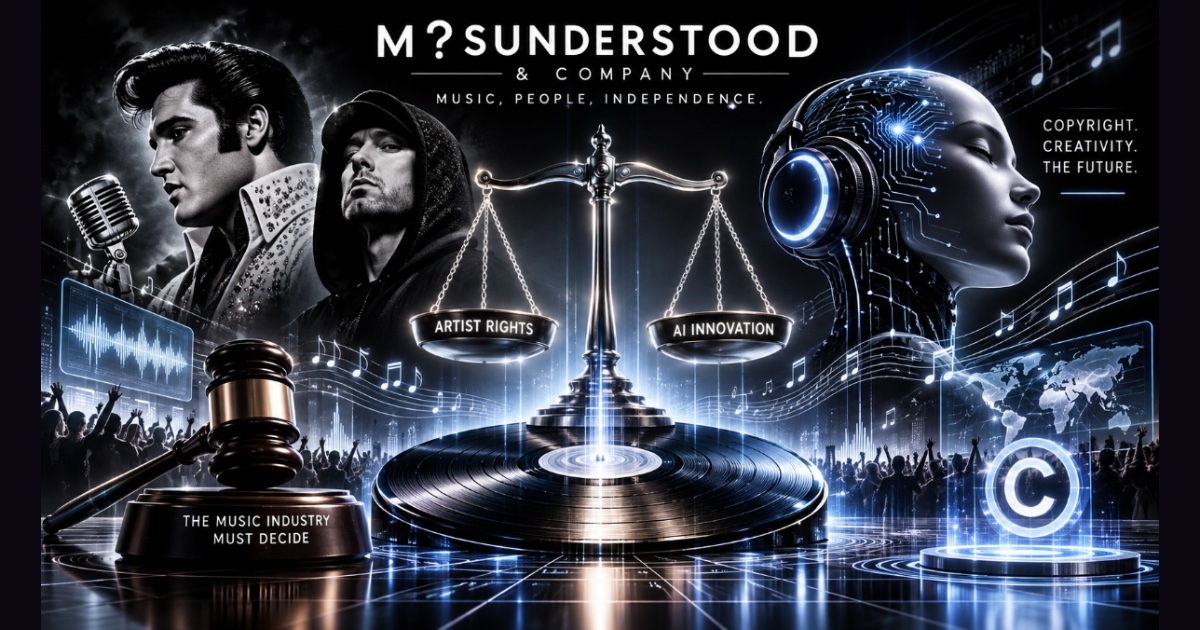
The Future of Music Is on Trial: Elvis, Eminem and the Battle Over Who Owns the Sound of a Generation
By Misunderstood & Company Editorial Desk
November 9, 2026 | Music Business | Technology | Intellectual Property
⸻
A machine can generate a song. But can it own the history that taught it how?
Imagine typing a few words into an artificial intelligence platform and receiving a professionally produced song in seconds.
The vocals sound familiar. The production evokes a legendary recording artist. The melody carries the atmosphere of a generation. The technology makes something that previously required musicians, producers, engineers, studios, and years of creative development appear almost effortless.
Now consider the question that the music industry can no longer avoid:
Who gets paid when a machine learns from somebody else’s music?
That question is at the center of two significant lawsuits filed against AI music-generation company Suno on November 6, 2026. The plaintiffs include copyright holders associated with Elvis Presley and Eminem, two artists whose influence on popular music extends across generations.
The allegations are serious. The implications could be enormous.
But this is not simply a dispute between famous artists’ estates and a technology company. It is a developing battle over the economic foundation of music itself: ownership, permission, compensation, identity, and the rights of the people who create the recordings and compositions that power the industry.
And independent musicians should be paying attention.
1. Two legendary catalogs. One enormous legal question.
According to Reuters, copyright holders associated with Elvis Presley and Eminem have filed separate complaints against Suno in the U.S. District Court for the Northern District of California.
The lawsuits were filed on November 6.
The first case, Elvis Presley Enterprises, LLC et al. v. Suno, Inc., is docketed as No. 3:26-cv-13398.
The second, Eight Mile Style LLC et al. v. Suno, Inc., is docketed as No. 3:26-cv-13399.
The plaintiffs allege that copyrighted musical works were improperly used in connection with training Suno’s artificial intelligence music-generation system.
The Elvis-related lawsuit also raises a separate question: whether AI-generated representations of Elvis Presley’s voice and likeness violate protections under Tennessee law.
These are allegations contained in legal complaints, not findings that Suno has been found liable.
That distinction matters. A lawsuit initiates a legal dispute; it does not establish that the plaintiff has already won.
Nevertheless, the cases put two different dimensions of artistic ownership directly into the spotlight:
* Copyright: Who has the legal right to reproduce, distribute, and authorize uses of protected musical works? * Identity: Who has the right to control the commercial exploitation of an artist’s recognizable voice and likeness?
The distinction could become one of the defining legal issues of the AI music era.
Sources: Reuters, November 9, 2026; U.S. District Court docket records.
2. The Elvis question: A voice is more than an instrument
Elvis Presley did not simply record songs. His voice became one of the most recognizable cultural signatures in modern entertainment.
That raises a particularly important question in the age of generative AI.
If a technology can produce a synthetic performance that listeners recognize as sounding like a particular artist, what rights protect that artist’s identity?
The Elvis-related plaintiffs invoke Tennessee’s Ensuring Likeness, Voice, and Image Security Act of 2024, commonly known as the ELVIS Act.
The legislation expanded Tennessee’s existing protections to expressly address a person’s voice and the unauthorized use of voice-replicating technology.
Its significance is substantial because the law recognizes that an individual’s voice can be a protectable commercial interest, rather than merely an incidental feature of a recording.
The Elvis-related complaint alleges unauthorized uses of Presley’s name, image, voice, and likeness, alongside copyright-related claims.
This creates two separate legal conversations.
First, whether copyrighted compositions and other protected works were unlawfully copied.
Second, whether a recognizable digital recreation of an artist’s identity was commercially exploited without authorization.
A company could face questions about one without necessarily being liable for the other.
That is why this dispute deserves to be examined beyond the headline.
3. Eminem’s catalog raises another critical issue
The Eminem-related lawsuit brings the focus back to the rights of songwriters, publishers, and music copyright owners.
Eminem’s music is not simply a collection of commercially successful recordings. It represents years of writing, composition, lyrical development, production, and creative investment.
The lawsuit was brought by Eight Mile Style LLC and Martin Affiliated LLC.
The plaintiffs allege that Suno improperly used copyrighted musical compositions associated with Eminem in connection with AI training and generated outputs.
This raises an uncomfortable question for the entire creative economy:
If an independent songwriter spends years developing an identifiable musical style, writing lyrics, creating compositions, and building a catalog, what happens when an AI company uses copyrighted material to develop a commercial system capable of generating new music?
The law does not automatically give someone ownership of an entire musical genre, artistic influence, or general style.
Copyright generally protects original expression, not abstract ideas, musical genres, or artistic techniques in themselves.
That distinction is essential.
An AI-generated song sounding like a particular genre is not automatically copyright infringement. Nor does every stylistic resemblance establish unlawful copying.
The actual questions involve what protected material was used, how it was obtained, what the resulting system reproduces, and whether the relevant legal requirements for infringement are satisfied.
Those questions cannot be answered simply by listening to a generated track.
4. The legal battlefield is bigger than copyright
The lawsuits arrive during an increasingly complicated period for American copyright law.
Under the Copyright Act, 17 U.S.C. § 106 establishes several exclusive rights belonging to copyright owners, including rights involving reproduction, distribution, and preparation of derivative works.
Section 501 addresses infringement of those rights.
However, AI training introduces difficult questions about how existing copyright principles apply to copying material for computational analysis and model development.
One of the most frequently discussed defenses is fair use under 17 U.S.C. § 107.
Fair use is not a blanket exemption for artificial intelligence.
Courts evaluate four statutory factors:
1. Purpose and character: Why was the material used, and how transformative was the use? 2. Nature of the copyrighted work: Was the original material highly creative or primarily factual? 3. Amount and substantiality: How much protected material was used in relation to the copyrighted work? 4. Market effect: What impact could the use have on the existing or potential market for the original work?
The analysis is fact-specific.
Commercial AI development does not automatically defeat fair use, but neither does describing a system as innovative automatically establish that its training practices are lawful.
There is another important dimension to these complaints.
The plaintiffs also raise allegations involving technological access protections and copyright management information.
Those issues can implicate the Digital Millennium Copyright Act, including 17 U.S.C. §§ 1201 and 1202.
The legal significance of those allegations is separate from the broader debate over whether AI training is fair use.
In other words, even if a defendant advances a fair-use argument concerning copyrighted material, that does not automatically resolve every other claim concerning how the material was obtained or how identifying copyright information was handled.
The details matter.
5. This is not Suno’s first legal battle
The new lawsuits do not exist in isolation.
Major music companies, including Warner Music Group, Universal Music Group, and Sony Music, have previously brought litigation involving Suno’s AI training practices.
Reuters reports that Warner Music Group has since settled its lawsuit, while the cases involving Universal Music Group and Sony remain ongoing.
The independent artist community has also entered the fight.
In Justice et al. v. Suno, Inc., No. 1:25-cv-11739, the U.S. District Court for the District of Massachusetts addressed several claims brought by independent recording artists and copyright holders.
In an August 20, 2026 memorandum and order, the court granted Suno’s motion to dismiss one count while denying the motion as to other challenged claims.
Importantly, that was a procedural decision, not a final determination that Suno had or had not infringed the plaintiffs’ copyrights.
It illustrates how courts are beginning to separate different legal theories rather than treating every AI-related claim as one universal copyright question.
This developing body of litigation could influence how future music-generation platforms approach licensing, training datasets, artist permissions, and commercial safeguards.
6. The independent artist is the person who cannot afford to be ignored
Here is where the conversation becomes especially important.
Major record labels have legal departments, intellectual-property attorneys, established licensing relationships, and significant financial resources.
Independent artists often do not.
A developing artist might spend years recording, mixing, mastering, distributing, promoting, and protecting a catalog.
They might pay producers, engineers, session musicians, and marketing professionals out of their own pockets.
They might own their masters. They might control their publishing. They might distribute independently.
But ownership on paper is only part of the equation.
Artists also need to understand what they are authorizing when they upload recordings to digital platforms, sign distribution agreements, accept licensing terms, or experiment with AI-powered production services.
A platform’s terms of service may contain provisions concerning uploaded material, processing, licensing, or the operation of its technology.
Those provisions should never be treated as interchangeable with copyright ownership.
Artists need to know what they own, what they license, what they surrender, and what they are being paid for.
This is not an argument against technological advancement.
Artificial intelligence can assist with production workflows, creative experimentation, accessibility, editing, and music discovery.
The question is whether technological progress can coexist with transparent permission structures and meaningful economic protections for the people whose creative work makes the industry valuable.
It should.
7. The technology industry has a legitimate argument, too
A serious examination of this dispute must acknowledge the other side.
AI developers argue that their systems create new forms of expression and that training models can involve transformative computational processes rather than simply redistributing original recordings.
They also argue that AI music-generation tools can lower barriers to entry, provide creative opportunities to people without access to expensive studios, and help users experiment with music.
Suno has previously maintained that its platform is intended to help users create original music and has described safeguards against unauthorized artist and song references, according to reporting by The Verge.
These arguments deserve consideration.
A legal system that protects artists must also be capable of evaluating genuinely new technologies without assuming that every computational use of existing creative material is necessarily unlawful.
But there is a difference between making innovation possible and treating the creative output of other people as an unlimited commercial resource.
That is the unresolved tension.
The future of AI music should not depend on the assumption that creators must accept whatever happens to their work simply because the technology exists.
Nor should copyright law be interpreted as a prohibition against every new creative tool.
The challenge is finding a sustainable legal and commercial framework.
8. Five questions that could reshape the music business
As these cases develop, several questions deserve attention.
QUESTION ONE: Does an AI company need permission to train on copyrighted music?
There is no single, universally applicable answer that resolves every AI-training scenario. The analysis depends on the works, the copying involved, the purpose, the relevant defenses, and the applicable law.
QUESTION TWO: Can an artist control an AI-generated version of their voice?
Potentially, yes. Rights of publicity and specific statutory protections may provide remedies against certain unauthorized commercial uses of a person’s identity. The scope depends on the jurisdiction and circumstances.
QUESTION THREE: Does owning a master recording automatically give an artist control over every use of the underlying composition?
No. Sound recording copyrights and musical composition copyrights are separate rights. Different parties can own or administer them.
QUESTION FOUR: Can an independent artist sue an AI company?
Potentially, if the artist or relevant rights holder has the necessary ownership, standing, and legally supportable claims. The outcome would depend on the evidence and applicable law.
QUESTION FIVE: Will AI music eventually require a standardized licensing economy?
That is one possible direction. Licensing frameworks, collective agreements, transparent training-data policies, and compensation mechanisms could become increasingly important as the market develops.
None of these questions has been universally settled by the filing of the new lawsuits.
But they are exactly the questions the music industry should be discussing.
9. The future should belong to creators, not just the companies building the machines
There is an important distinction between celebrating technological progress and ignoring the people whose work makes that progress possible.
Music has always evolved through technology.
The electric guitar changed popular music. Multitrack recording transformed production. Sampling reshaped hip-hop. Digital audio workstations democratized recording. Streaming changed distribution.
Every major technological shift created opportunities, disruption, and new disputes over economics and ownership.
Artificial intelligence represents another major transition.
But this time, the technology can potentially generate entire musical performances, imitate recognizable voices, and produce compositions at a scale that traditional production workflows could never match.
The commercial stakes are therefore significant.
If artists cannot understand how their catalogs are being used, they cannot make informed decisions about licensing.
If platforms cannot explain their training practices, rights holders may have difficulty evaluating whether their interests are being respected.
If audiences cannot distinguish an authorized collaboration from an unauthorized synthetic performance, trust in music’s relationship with its creators could become increasingly complicated.
The industry needs transparency.
It needs meaningful licensing conversations.
It needs protections for creative identity.
And it needs an approach that allows independent artists to participate in the technological future without becoming invisible in its economic structure.
THE FINAL VERDICT: THE MUSIC INDUSTRY MUST DECIDE WHAT PROGRESS ACTUALLY MEANS
Elvis Presley and Eminem represent different generations, different sounds, and different moments in popular music history.
Yet their names now appear in the same developing conversation about artificial intelligence and creative ownership.
That alone tells us something important.
This is no longer a hypothetical debate about what AI might eventually do to music. It is an active legal and commercial conflict involving recognizable artists, valuable catalogs, and companies developing technology that could change how music is created and distributed.
The courts will have to evaluate the evidence, the applicable statutes, and the competing legal arguments.
Until then, the allegations remain allegations.
But one principle deserves to remain at the center of the conversation:
Innovation should create new opportunities for artists, not make the value of their creative labor disappear.
The next era of music should not force creators to choose between embracing technology and protecting what they have built.
The real challenge is making sure both can exist.
Because if the future of music is being built from the sounds of the past, the people who created those sounds deserve a meaningful place in the conversation about what happens next.
⸻
THE MISUNDERSTOOD PERSPECTIVE
At Misunderstood & Company, we believe the future of music must include the people behind the music.
The conversation about artificial intelligence should not stop at convenience, creativity, or technological achievement. It must also address ownership, transparency, compensation, and the independence of artists.
Technology should empower creators.
It should not make creators an afterthought.
Recognizable at 12px. Unforgettable at 120px.
Misunderstood & Company — Music, People, Independence.
⸻
SOURCES & FURTHER READING
1. Reuters — Elvis, Eminem copyright owners sue Suno over AI training, November 9, 2026. 2. U.S. Copyright Office — Copyright and Artificial Intelligence. 3. U.S. District Court, District of Massachusetts — Justice et al. v. Suno, Inc., August 20, 2026. 4. U.S. District Court docket — Eight Mile Style LLC et al. v. Suno, Inc.. 5. U.S. District Court docket — Elvis Presley Enterprises, LLC et al. v. Suno, Inc.. 6. Tennessee General Assembly — ELVIS Act legislative materials.
Editorial and legal accuracy note: This article discusses pending litigation and evolving legal questions. Allegations are attributed to the parties bringing them. No liability determination is implied. This is journalism and general legal information, not legal advice. Misunderstood & Company is not affiliated with, sponsored by, or endorsed by Suno, Elvis Presley Enterprises, Eight Mile Style, Eminem, or the other parties discussed.
A COMMUNITY FOR THE WORK
See artist profiles and join the member conversation. Member posts, likes, and comments are available after sign-in.
ARTISTS · CONSUMERS · COMMUNITY
Create a free account to follow the conversation, publish posts, and build a profile with your photo and social links.
Create your accountJOIN THE COMMUNITY
Create a free account to share updates, follow the community, and set up your artist profile.
Artists may publish a track to the public Misunderstood player after confirming they have the necessary rights. Private Artist Release Studio drafts are not public; the studio does not deliver music to external streaming services, and monetization and royalty payouts are not active.
THE COMMUNITY
Share what you’re making, find independent music, and meet the artists behind it.
Sign in or create a free account to unlock the For You and Latest feeds, see member posts, share updates, and support artists.
A creative workforce-development institution where independent artists can create, learn, work, earn, and build sustainable careers without needing wealth or industry connections to participate.
COIN HUB
Visible only to accounts on the site owner allow-list. Wallet tools below are a read-only preview; nothing is sent or signed.
Choose an installed EVM or Solana wallet to view its public address and network for this visit. We never request recovery phrases or sign transactions.
ARTIST-OWNED MARKETPLACE
Explore digital albums, vinyl, CDs, cassette tapes, USB releases, floppy disks, and artist-made goods. Every listing belongs to an artist-run store, with prices and formats shown up front.
Checking checkout availability…
YOUR COLLECTION / ONLY YOU
Loading approved listings…
Try a different artist, product name or format.
Public tracks from artists who publish here appear in the player below. Private release drafts are not public or playable.
Loading published tracks…
Meet the artists. Follow their work and find them on their platforms.
Artist / Musician / Songwriter
@iammonicawhitlock
Follow this artist’s linked channels for music and updates.
Artist / Producer / Songwriter / Mixing & Mastering Engineer
@kgrsdream
Follow this artist’s linked channels for music and updates.
Artist / Musician
@jallen
Follow this artist’s linked channels for music and updates.
Artist / Musician / Producer / Songwriter
@elloudski
Follow this artist’s linked channels for music and updates.
Artist
Follow this artist’s linked channels for music and updates.
One-on-one lessons from a working producer and engineer. Tell us what you want to learn and we'll set up your first session.
Build beats and full songs from the first idea to a finished track.
Recording, editing and signal flow, so your sessions sound right from the start.
YOUR SONG. YOUR SOUND. A REAL ENGINEER.
Upload your song or stems once. Answer a few focused questions so an engineer knows what to listen for, then review the scope before work begins.
Start a mix requestPrivate by default. Your source audio is not a public release. You review the engineer's scope and quote first; submitting does not charge you.
Checking your workspace...
OPT-IN ACTIVITY PILOT
A non-cash pilot for artists and fans. Eligible public listens can credit one listener discovery point and one artist support point when both accounts opt in.
At least 30 audible seconds, server elapsed-time checks, one credit per member/track/day, and a 20-listen daily cap apply. Private rehearsals, self-listens, muted listening, and repeats do not qualify. Client-reported listening is not independent proof of listening; this pilot must never fund financial payouts.
Checking the pilot...
Any future financial or on-chain system requires a defined funding source, independent playback verification, anti-fraud controls, jurisdictional review, audited contracts, and explicit user consent. None is live here.
A private publishing workspace for release metadata, ISRC/UPC records assigned to your label, and master-file preparation.
LABEL & ARTIST WORKSPACE
Choose a workspace below. Music Releases is for singles, EPs and albums, track-by-track metadata, private masters, ISRCs and delivery manifests. Merch & Seller Store is for clothing, artist-made products, physical music and digital album sales. External streaming delivery is not connected; import distributor statements for outside-platform reports.
Sign in with an artist account to use your private Artist Release Studio.
YOUR SOUND. YOUR CONTROL.
Your songs, artwork and real on-site activity, together. Private stays private until you choose to publish.
Preview private masters, update each song's artwork, publish deliberately, and inspect its analytics.
Save a private rehearsal first, or deliberately publish to the public player. Private masters are only available to your artist account. Albums and EPs use the full release builder below.
Send a song for mixing / masteringYOUR ARTIST PROFILE
Post a release teaser on your artist profile. This does not upload audio or send music to streaming stores.
Saving here prepares private masters and metadata; it does not deliver music to outside stores or make an unassigned identifier official.
ARTIST STOREFRONT
Connect Stripe, add products, set a price and stock, and manage your orders here. Marketplace sales carry a 5% platform fee; Stripe processing charges are separate.
MARKETPLACE SELLER APPLICATION
Tell us who you are, what you plan to sell, and what your work contributes. Applications go to hello@misunderstoodandcompany.com for review.
Checking your Stripe setup…
Your legal name, contact and return address, and seller application answers are sent privately to the Misunderstood & Company review team. They are not displayed on your public store.
PRIVATE MARKETPLACE OPERATIONS
Review applications and listings in one place. Store approval and product approval are separate; both are required before anything goes live.
Sign in with an approved reviewer account to access seller applications.
Back to Artist Release StudioAPPLICATION QUEUE
Review each application before enabling a store. Every product is reviewed separately.
Checking reviewer access…
Approve or reject each product listing. Sellers see your note when a product is rejected.
Loading product submissions…
SITE-ADMIN ACTIVITY
Admin-only metadata for seller, product, payout, and site-admin changes. No application answers or payment details are recorded here.
Checking site-admin access…
Move every story still pointing to the shared public media bucket—including expired stories and stories by other members—to private storage. Each old-object removal is tracked and verified, so interrupted runs can resume. Post and avatar media are unchanged. Public files orphaned by older failed deletions have no story-row reference and need a separate bucket inventory.
Available to site admins with verified MFA.
Move existing post photos and videos out of the public media bucket. New post uploads use authenticated private storage. Profile avatars and legacy stories remain in the shared media bucket; any unlinked old files need a separate inventory.
Available to site admins with verified MFA after migration 0819 is installed.
Automatic ISRCs are issued from the label's own registrant prefix and recorded permanently so none is ever reused; confirm the prefix with your national ISRC agency. Store delivery still requires a distribution partner, and CSV export is preparation for submission to your distributor; it is not a delivery to any store. Do not upload audio unless you own or control the master.
ABOUT MISUNDERSTOOD & COMPANY
A home for independent artists and consumers to discover music, share work, and grow on their own terms.
About the companyArtist partnerships, music video projects, production, bookings and collaborations.
contact@misunderstoodandcompany.com